₹25 Lakh moved.
₹10 Lakh kept.
Zero invested.
A negative working capital student logistics business run entirely from a hostel room. No external funding. No owned buses. Just pure execution.
01. The Context
Not a transport problem.
A coordination problem.
Every vacation, VIT Bhopal students faced the exact same chaos. Thousands of people needed to leave an isolated campus at the exact same time.
The result? Expensive cabs, unreliable local vendors, panicked last-minute WhatsApp groups, and deeply confused first-year students.
This wasn't a lack of buses. It was a recurring demand concentration problem with massive monetizable urgency. Everyone was going to the same stations, but nobody was organizing the flow.

02. The Hidden Foundation
The failed idea that secretly built this.
In my first year, I attempted a college trip-planning startup. It failed spectacularly due to poor planning.
But during that failed attempt, I spent hours talking to local bus vendors. I learned their routes, understood their pricing thresholds, and figured out trip economics. When the VBS coordination problem became obvious, I didn't have to start from scratch. I already had the vendor network on speed dial.
"No experiment really dies if it leaves behind useful assets."
03. The Execution Protocol
Demand first.
Supply later.
I never blindly committed to leasing a bus. Every single decision was driven by hard data collected manually through a strict pipeline.
04. The Engine
The Negative Working Capital Machine.
1. Buses were leased 10–15 days before the trip.
2. Students paid the full amount in advance based on trust.
3. Occupancy and revenue were mathematically confirmed before any hard commitment.
4. Vendor settlement happened near or often after trip completion.
"The business never needed my money.
It needed my coordination."
05. Operational Realism
What a single trip actually looked like.
Day -15
Demand Capture
Float forms, watch the spreadsheet fill up, identify heavy routes.
Day -12
Vendor Negotiation
Call operators. Lock in bus sizes based on exact demand density.
Day -10
Payment Checking
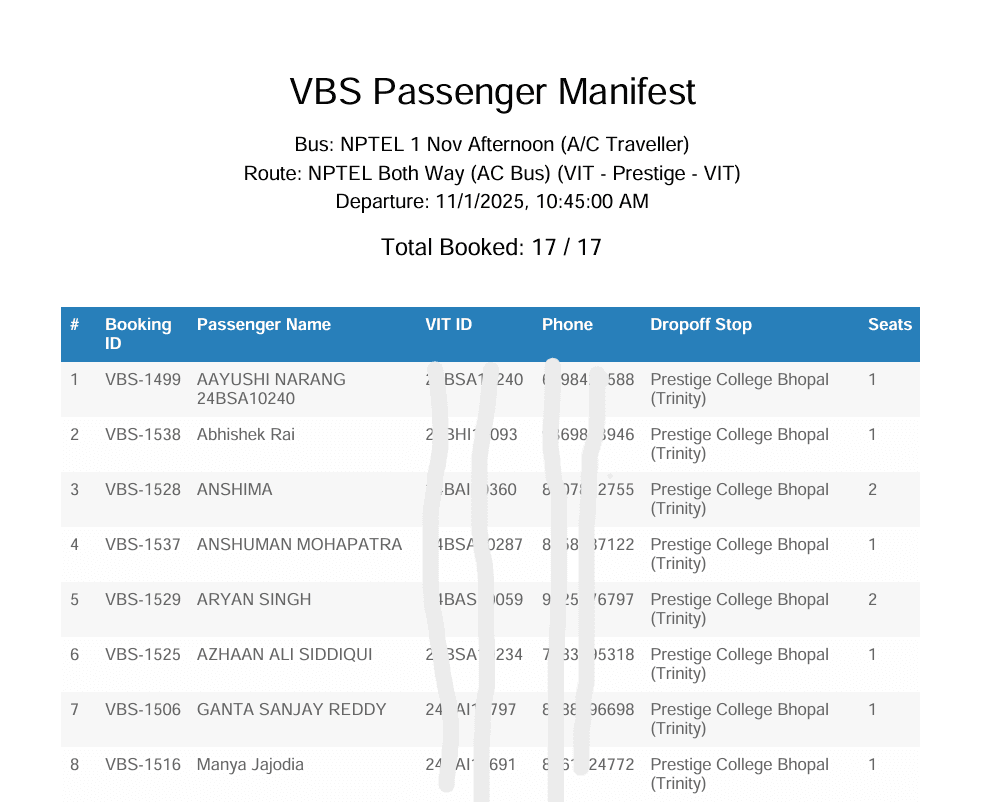
Open bookings. Verify hundreds of UTR numbers against screenshots manually.
Day -3
Seat Confirmation
Finalize boarding lists. Send confirmation messages. Handle the inevitable 'can I still book' panic.
Day 0 (2 AM)
Departure Day
Coordinate bus arrivals at campus gates. Manage crowds. Deal with students arriving late.
Day 0 (4 AM)
Issue Resolution
Handle angry calls if a bus breaks down or a driver gets lost. The ultimate pressure test.

06. Scaling Systems
When manual work started killing sleep.
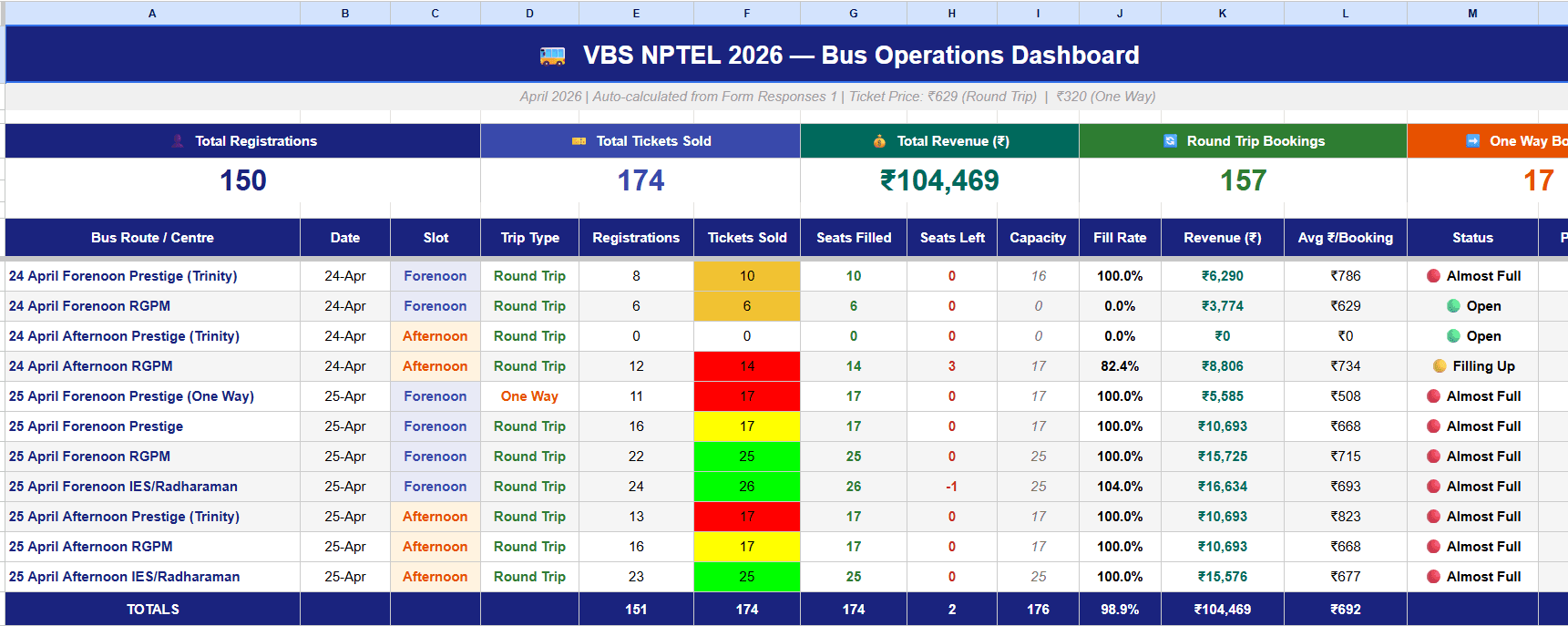
Initially, everything was manual: checking payment screenshots, matching UTR numbers, marking confirmed statuses, and building boarding sheets.
As bookings skyrocketed, late-night repetitive work became a massive bottleneck. I realized I was wasting hours on mechanical checking instead of high-leverage decision making.
So, I built Google Sheets logic, Apps Script triggers, and helper workflows to auto-verify, filter, and segment.
"Whenever operations started becoming mechanical, code entered."
07. Authenticity
Not every bus left smoothly.
VBS wasn't a romanticized startup journey. It was earned through pure chaos.
There were last-minute cancellations. Nonstop phone calls from panicking students. Vendor delays. There were trip experiments, like the Pachmarhi route, that completely failed. Carrying the pressure of 10,000+ students trusting you with their money and their travel home is heavy. But navigating that pressure is what separated this from a simple college project.
08. What This Actually Taught Me
Demand over Supply
Never commit capital until the market mathematically demands it.
Pricing & Urgency
Price confidently above comfort when you are solving high-urgency pain.
Trust Compounds
Trust builds faster than any marketing campaign ever could.
Systems vs Mechanics
Manual operations are painful, but they explicitly reveal where code is actually needed.
Cash Flow Timing
Cash timing matters infinitely more than theoretical margin.
Coordination is the Product
In fragmented markets, simply organizing the chaos is a highly profitable business model.
09. The Baseline
My practical MBA in execution.
VBS matters on this website not because it was a "college startup".
It matters because it was the crucible where I learned customer psychology, vendor negotiation, logistics, money timing, and building trust at scale under immense operational pressure.